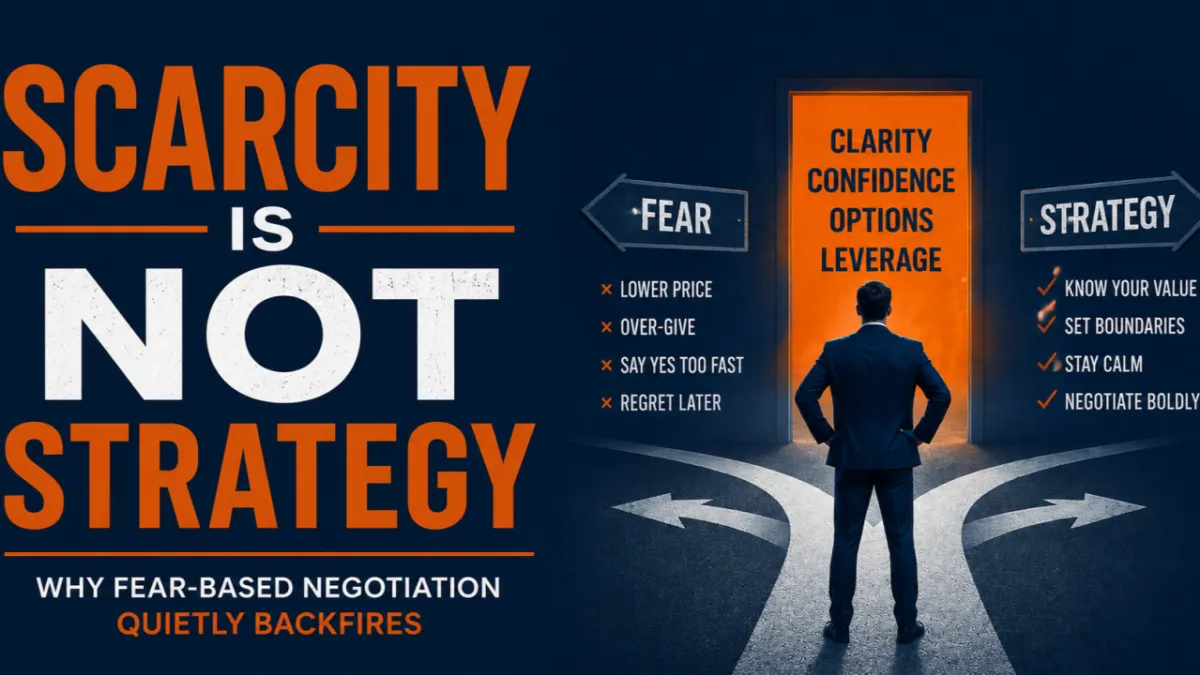
Fear-Based Negotiation: Why Scarcity Costs You Leverage
Why Fear-Based Negotiation Quietly Backfires
There’s a sentence people say to themselves right before they give away leverage.
Most of the time, they don’t even realize they’re saying it.
It sounds like:
“I can’t afford to lose this.”
And once that sentence enters the negotiation…
everything changes.
The tone changes.
The posture changes.
The willingness to hold the line disappears.
People soften their position before the other side even pushes back.
They lower pricing before anyone objects.
They absorb scope before anyone asks.
They over-explain.
Over-accommodate.
Over-give.
Not because they’re weak.
Because fear quietly became strategy.
Meet David
David owns a growing consulting company.
Good reputation. Strong work. Smart operator.
A large opportunity landed on his desk earlier this year.
The kind of client that feels like a breakthrough.
Bigger visibility. Bigger revenue. Bigger future potential.
He prepared carefully.
Knew the value of the work.
Understood the complexity of the engagement.
Had a clear number in mind before the call started.
Then the conversation began.
The client casually mentioned budget pressure.
Nothing aggressive.
Nothing confrontational.
Just enough.
And internally, David shifted.
“Don’t lose this.”
That was the moment the negotiation changed.
Not externally.
Internally.
Suddenly he started solving problems the client hadn’t even raised yet.
Reducing scope before objections appeared.
Explaining why he could “be flexible.”
Trying to make the deal feel safer.
The client didn’t pressure him into concessions.
David negotiated himself downward first.
And afterward?
He knew it.
That’s the painful part.
Most people realize it later.
Driving home.
Lying awake.
Replaying the conversation.
“Why did I say that?”
“Why did I move so quickly?”
“I should have held the line.”
But by then, the negotiation is over.
Scarcity Changes Behavior Faster Than Logic
This is what people misunderstand about negotiation pressure.
Scarcity doesn’t just affect decisions.
It affects identity.
The moment someone believes:
“I need this deal.” “I can’t afford conflict.” “I don’t have another option.”
their nervous system starts negotiating for safety instead of strategy.
That’s when people:
accept bad terms
avoid hard conversations
collapse pricing
overcommit
tolerate misalignment
protect the relationship at the expense of themselves
And the dangerous part?
It often looks professional.
Reasonable.
Collaborative.
But underneath it is fear.
Not strategy.
The Problem Isn’t Confidence
A lot of capable professionals think they need more confidence.
Usually they need something else.
A clearer relationship with alternatives.
Because leverage changes when survival disappears from the equation.
This is why Phil Danielson talks so often about the importance of a Plan B.
Not because walking away is the goal.
Because knowing you can changes how you show up.
Calmer.
Clearer.
Less reactive.
Less desperate to force agreement.
The strongest negotiators are not always the loudest.
Often they are simply the least afraid of losing the deal.
Fear Creates Expensive Shortcuts
Scarcity thinking pushes people toward immediate relief.
That creates short-term decisions with long-term costs.
Examples:
discounting to avoid discomfort
saying yes too quickly
avoiding clarification
skipping boundaries
accepting unclear expectations
agreeing before evaluating
The relief feels good for a moment.
Then the consequences arrive later.
Usually disguised as burnout, resentment, margin erosion, or leadership exhaustion.
The Internal Negotiation Comes First
Most negotiations are decided long before numbers appear.
They’re decided in the internal conversation happening beforehand.
Questions like:
“What if they walk?”
“What if I lose this?”
“What if pushing creates tension?”
Those thoughts shape behavior immediately.
And behavior shapes outcome.
At The Bold Negotiator, this is foundational:
Under pressure, you do not rise to strategy.
You fall to behavior.
If fear is driving the behavior, scarcity will shape the result.
A Better Question
Instead of asking:
“How do I keep this deal alive?”
Try asking:
“What happens if I stop negotiating from fear?”
That question changes things.
Because the goal is not aggression.
The goal is clarity.
To stop treating survival instincts like strategic thinking.
To recognize when fear is quietly running the room.
Before Your Next Important Conversation
Pause and ask yourself:
Where am I assuming scarcity?
What am I protecting?
What am I afraid will happen?
Where am I negotiating against myself before the conversation even begins?
What would change if I believed I had options?
Because the moment fear becomes strategy…
you start giving away leverage before anyone asks for it.
And most people never realize how expensive that becomes until much later.