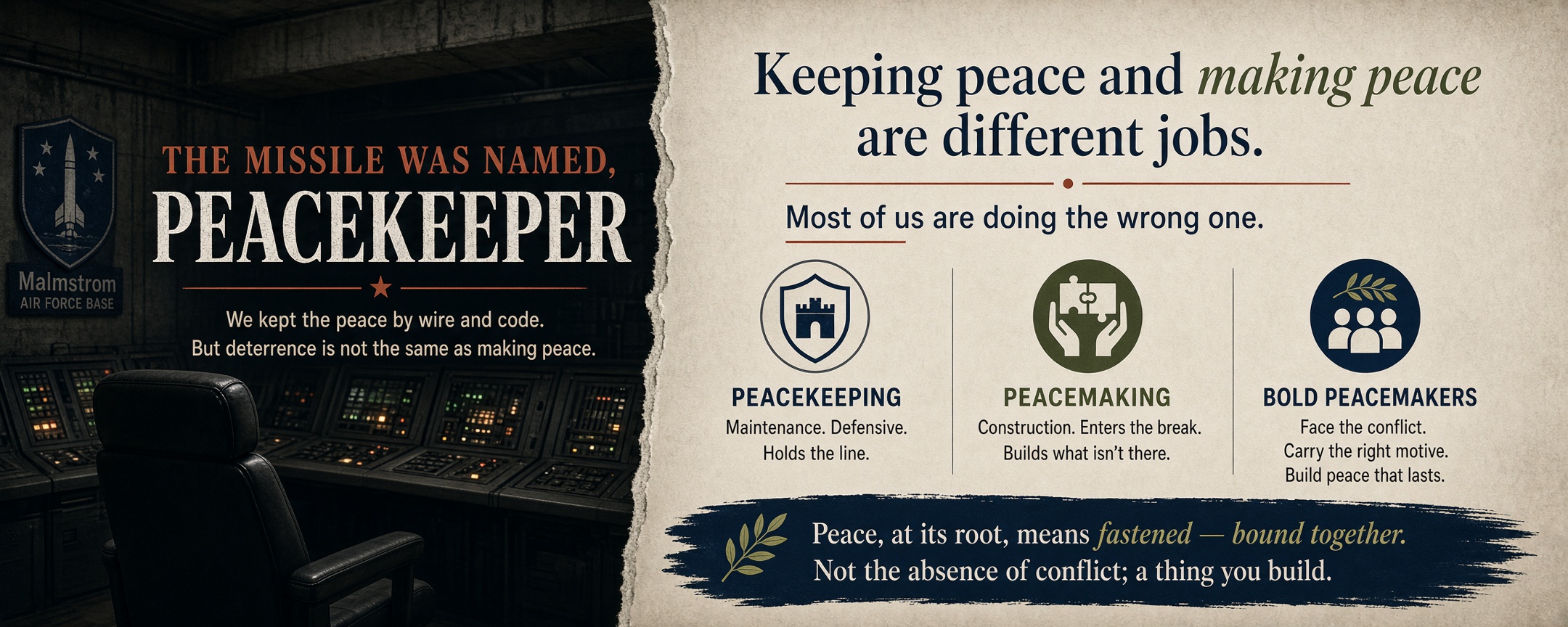
The Missile Was Named Peacekeeper
Two of us sat sixty feet under the Montana prairie, on alert over ten nuclear missiles we would never see.
That was my job for several years: Air Force launch officer, Minuteman III, Malmstrom Air Force Base outside Great Falls. The missiles stood in silos scattered across the plains, miles from our capsule. We kept the peace by wire and code, from a great distance, without ever looking the thing itself in the eye.
And in those years, the newest missile in America's arsenal — fielded with our sister wing down at F.E. Warren in Wyoming — was named, without any apparent irony, the Peacekeeper.
Thirty years I've chewed on that name. Because the name was accurate — and that's exactly the problem.
Those missiles kept the peace. They did it by deterrence: by making the cost of conflict so unthinkable that nobody started one. And deterrence works — nothing I sat alert over was ever fired. But deterrence resolves nothing. It freezes a conflict in place and calls the frost "peace."
Years later, after law school and a career spent negotiating for a living, I finally found the words for what bothered me about that name.
Keeping peace and making peace are different jobs. Most of us are doing the wrong one.
You cannot keep what hasn't been made
Peacekeeping is maintenance. It's defensive. It holds the line, avoids the breach, keeps things from getting worse. It's what I did in that capsule: control at a distance, miles between me and the conflict itself. Honorable work.
Peacemaking is construction. It begins, by definition, where peace does not exist. Inside the conflict, not under the prairie miles away from it. Peace, at its root, means something fastened — bound together. Not the absence of conflict; a thing you build, line upon line, usually by someone willing to walk into the middle of the break.
An ancient sermon puts it this way: "Blessed are the peacemakers." Not the peaceful. Not the peaceable followers with calm dispositions and conflict-free lives. The peacemakers — the ones who construct peace where it isn't.
Most professionals I work with are peacekeepers who believe they're peacemakers. The client relationship feels tense, so they don't raise the fee. The scope keeps creeping, so they absorb it. The invoice gets questioned, so they discount it. And they tell themselves they're preserving the relationship.
They're not. They're running deterrence. Managing the conflict from a distance, by wire and code, never looking it in the eye. The resentment compounds. The margin erodes. The conversation they're avoiding doesn't disappear; it just gets more expensive.
Recently I taught a session to 335 accounting professionals — partners, CFOs, firm owners. I polled them: Do you have a written walk-away number for your typical engagement? Eighty-eight percent said no. These are people who negotiate for a living, keeping the peace on every engagement, with no idea where their own line is. You can't defend a border you've never drawn. And you can't make peace you've never defined.
Don't hide behind the noble word
This is where I have to be careful, and so do you.
"Peacemaker" can become a hiding place. It can dress up timidity as virtue and submissiveness as diplomacy. I didn't raise the issue because I'm keeping the peace. No — you didn't raise the issue because raising it is uncomfortable, and you've found a noble-sounding word for the avoidance.
Real peacemaking is the opposite of hiding. Conflict, by itself, is morally neutral — some of the most important work of your life will happen inside one. What corrodes is contention: conflict driven by ego, by the need to win, to humiliate, to be vindicated. The difference between a hard conversation that heals and one that wounds is rarely the content. It's the motive.
History knows both kinds of peace. Some peace is made by literally burying the weapons — whole peoples have done it, at staggering cost, and kept that covenant to the grave. And some peace is kept because the next generation had the courage to stand watch so the burying could hold. Both are honorable. Neither is timid.
Which means a peacemaker can be bold. A peacemaker can name the problem plainly, hold the number firmly, and say the sentence that makes the room go quiet — as long as the motive is the other person's wholeness and not your own victory. Boldness and peace are not opposites. Used in the service of resolution, boldness is a more excellent way of doing both.
People read your face before they hear your words
So what separates the bold peacemaker from the aggressive negotiator wearing peacemaker's clothing? I learned the answer from my father.
As I've grown older, I've come to resemble him more every year. After he passed away, something changed. I didn't just see the resemblance in the mirror. I saw him in me. I feel him close, still. There's a presence that goes beyond physical resemblance. It came from years of shared life, of doing what he did, absorbing his values until I didn't just look like him. I carried him. That did not happen in a moment.
That's what people are reading when you walk into a hard conversation. Not your script. Your countenance. They sense, before you finish your first sentence, whether you came to win or to serve. Whether you're an honest broker or a combatant with better manners. You cannot fake it, because it isn't produced in the moment. In my faith we'd ask whose image you carry in your countenance. In a negotiation seminar I'd ask whether they believe you're acting in good faith. Same question.
The hardest table is your own side's
One more thing the missile years never taught me, and the Good Friday Agreement did.
When Northern Ireland's peace was negotiated in 1998, the grievances on both sides were legitimate. Nobody was inventing their suffering. The real peacemaking didn't happen across the table. It happened when leaders went back to their own people, to their own hardliners, and said: Yes, you were wronged. Yes, it's real. And we're going to lay it down anyway — because we choose the next generation over vindication.
That's the part nobody wants: peacemaking usually costs you something with your own side. The partner who tells his firm "we're raising rates and honoring our value" faces his own people first. So does the leader who ends a discount culture, and the parent who ends a family cold war by apologizing first.
Deterrence never asks that of you. That's why it's easier — and why most of us stay in the capsule.
I spent years keeping peace from a capsule in Montana, miles from the missiles I controlled. I've spent the decades since learning to make it — at negotiation tables, in client conversations, in my own family. The keeping was honorable. The making is better. Peace, I've learned, rarely arrives with fanfare. It comes still and small, one fastened line at a time.
The peace you're keeping — was it ever made? Or are you managing a frozen conflict from a safe distance and calling it a relationship?
Somewhere in your week there's a conversation you've been deterring. Close the distance. Bring your number and the right motive. Make the peace instead.